
NewsDetails
Large Diameter Steel Pipes Manufacturing Industrial Applications
author:Zhantong time:2026-07-22 09:24:32 Click:151
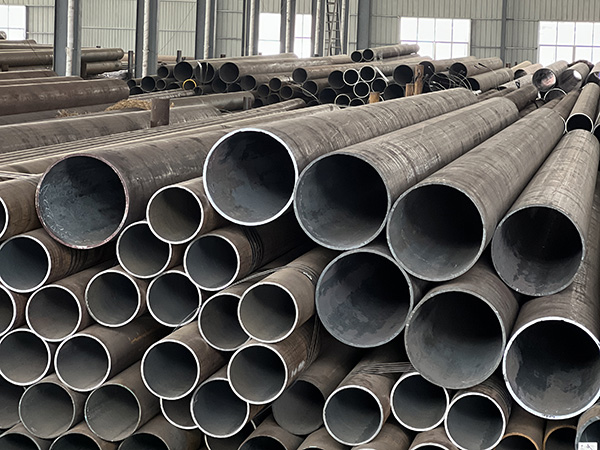
Large diameter steel pipes—typically defined as exceeding 24 inches (610mm) nominal size—form the arterial infrastructure that transports essential resources across continents and beneath oceans. These massive steel cylinders demand specialized manufacturing techniques, sophisticated quality systems, and careful logistics planning. Understanding the production methods and application requirements helps engineers and procurement specialists navigate the unique challenges of large pipe projects.
Manufacturing Methods: SSAW versus LSAW
Spiral submerged arc welding (SSAW) produces pipes by helically winding steel strip at controlled angles around a rotating forming mandrel. The continuous strip forms the pipe shell, with the spiral seam welded by submerged arc welding. This method offers remarkable diameter flexibility—single-width coils can produce pipes from approximately 24 to 80 inches or more—reducing inventory requirements for diverse project needs.
Longitudinal submerged arc welding (LSAW) creates pipes from steel plates formed into cylinders and welded along the longitudinal axis. The UOE process—named for its forming stages—shapes plates into approximate cylinders, then expands slightly to reduce residual stresses. This method produces pipes with excellent dimensional accuracy and consistent mechanical properties that suit demanding transmission applications.
Steel Plate Production and Quality Requirements
Large diameter pipe quality begins with steel plate manufacturing. Thermomechanical controlled processing (TMCP) produces plates with fine grain structures and excellent toughness through carefully controlled rolling and cooling schedules. These advanced steels allow reduced wall thicknesses for equivalent strength, offering material savings that substantially affect project economics.
Plate inspection employs ultrasonic testing to detect internal laminations or inclusions that could compromise pipe integrity. Edge inspection verifies proper bevel geometry for subsequent welding operations. Hydrostatic testing of finished plates ensures freedom from through-wall defects before pipe manufacturing commences.
Forming and Welding Operations
SSAW forming rolls progressively shape the strip into cylindrical form, with the spiral angle determining the ratio between strip width and resulting pipe diameter. Precise forming control prevents buckles or wrinkles that would create rejectable pipe. The inside and outside welds proceed simultaneously or in sequence, with each pass contributing to the final weld profile.
LSAW JCOE forming hydraulically shapes plates through progressive pressing stages, each forming approximately 15-20 degrees of the final cylinder. Internal and external tandem welding heads deposit multiple passes that build up the weld reinforcement. Automatic weld tracking systems maintain proper bead placement as the pipe progresses through welding stations.
Hydrostatic Testing and Quality Verification
Finished large diameter pipes undergo hydrostatic pressure testing that validates pressure-containing capability. Test pressures—typically 90-90% of specified minimum yield strength divided by design stress ratio—stress the pipe to levels approaching yield. The test duration—minimum 10 seconds per specification—provides opportunity to detect through-wall leaks or pressure drops indicating significant defects.
Dimensional verification ensures pipes meet tolerance requirements for diameter, wall thickness, and out-of-roundness. Automated measurement systems capture data along the pipe length, identifying sections outside specification limits. These measurements also confirm proper bevel geometry for subsequent field welding operations.
Coating Application for Corrosion Protection
External coating application occurs immediately after pipe manufacturing while surfaces remain clean and warm from welding residual heat. Fusion-bonded epoxy (FBE) provides the foundation layer, with three-layer polyethylene or polypropylene systems adding mechanical protection. The coating line incorporates pre-heating, surface preparation, coating application, and curing stages that produce consistent coating quality.
Field joint coating—applied where pipe sections join during construction—represents a critical interface between mill-applied coating and long-term protection. Heat-shrink sleeves, liquid epoxies, or polyurethane systems must match mill coating performance to prevent premature failures at these vulnerable locations.
Logistics and Transportation Considerations
Large diameter pipe transportation presents substantial logistics challenges. Over-dimensional loads may require special permits, route surveys, and police escorts for highway transport. Rail transport accommodates longer loads but imposes dimensional constraints. Ocean vessel chartering for overseas shipments involves careful coordination of vessel availability, port capabilities, and cargo securing requirements.
Project planning must account for pipe delivery timing that matches construction progress without creating excessive on-site storage requirements. Pipe yards at fabrication facilities or project sites must provide adequate space, drainage, and dunnage to prevent pipe damage or coating abrasion. Quality verification upon delivery—including holiday detection for coating defects—protects against transport-related damage.
Inviting global distributors to join our large diameter pipe supply network. We partner with distributors experienced in pipeline project logistics who understand the specialized requirements for transporting and handling these massive steel products.
References
API 5L: Specification for Line Pipe, 46th Edition
ISO 3183:2012: Petroleum and natural gas industries—Steel pipe for pipeline transportation systems
ASTM A672/A672M-20: Standard Specification for Electric-Fusion-Welded Steel Pipe for High-Pressure Service
ASME B31.4: Pipeline Transportation Systems for Liquids and Slurries
Pipeline & Gas Journal, April 2021: Advances in Large Diameter Pipe Manufacturing
 Recommended Products
 Contact us
—— Contact:Manager
—— Tel:+86 15231788966
—— Email:info@zhantongpipe.com
—— Url:https://www.zhantongpipe.com
—— Address:Mengcun Hui Autonomous County, Cangzhou City, Hebei Province