
NewsDetails
Equal Reducing Tees Pipe Branch Connections Guide
author:Zhantong time:2026-08-02 16:38:59 Click:126
A tee splits or combines flow, creating a branch that leaves the main run at a right angle. It is one of the most common fittings in any piping system, yet the choice between an equal tee and a reducing tee, and the way the branch is reinforced, affects both flow performance and long-term integrity. Understanding these fittings helps designers build branches that stay leak-free for decades.
Equal Tees and Reducing Tees Compared
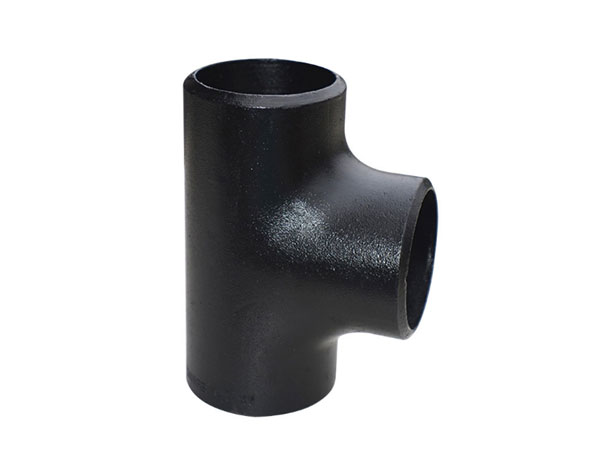
An equal tee has a branch the same size as the run, producing a symmetrical fitting where all three openings share a common diameter. A reducing tee carries a smaller branch than the main run, allowing a smaller line to tap off a larger header without a separate reducer. Choosing a reducing tee where the branch is genuinely smaller saves a fitting and a weld compared with combining an equal tee and a reducer.
Both types are made to standard dimensions so they mate cleanly with pipe of matching schedule, keeping fabrication predictable across a project.
Flow Behavior at the Branch
Where flow divides or merges, turbulence rises. A well-formed tee with smooth internal contours limits that turbulence and the associated pressure loss. In headers feeding several branches, the cumulative effect of many tees influences the pressure available at the far end, so smooth, correctly sized fittings help maintain balanced distribution.
For services sensitive to erosion, the branch junction is a wear point because the fluid changes direction there. Anticipating this during design, and specifying adequate wall thickness, protects the tee from premature thinning.
Reinforcement and Pressure Integrity
Cutting an opening in a pressurized run removes metal that carried hoop stress, so the branch area must be reinforced to restore strength. Factory-made butt-weld tees are designed with extra metal at the crotch to provide this reinforcement built into the fitting, which is why a standard tee is generally preferred over a fabricated branch for pressure service.
When a branch is fabricated in the field instead, reinforcing pads or integrally reinforced fittings compensate for the removed metal. Codes provide the calculation methods that confirm the reinforcement satisfies the pressure demand at the opening.
Standards and Materials
Butt-weld tees follow ASME B16.9 for dimensions and tolerances. Carbon and alloy steel tees are specified under ASTM A234, while stainless grades fall under ASTM A403. Wall thickness matches the connected pipe schedule, ensuring welds join members of equal thickness for a sound joint.
Material selection follows the fluid and temperature, with corrosive or high-temperature service justifying alloy or stainless grades. A quality-focused manufacturer supplies tees with certified test reports so buyers can verify chemistry and properties before installation.
Fabrication and Quality Control
Tees are commonly produced by hydraulic forming, where a section of pipe is expanded outward to form the branch, followed by sizing and heat treatment. This process yields a seamless, smoothly contoured fitting with reinforcement designed into the crotch. Dimensional checks confirm branch height, run length, and wall thickness meet the standard.
A reliable supply partner maintains consistent forming and inspection so every tee aligns properly during fit-up and performs to its rating. Traceable documentation ties each fitting to its material heat, supporting quality assurance across the project.
Selecting the Right Tee
Match the tee type to the branch size, choosing a reducing tee where the branch is smaller to save a fitting and a weld. Confirm the material suits the fluid and temperature, and rely on factory-made tees with built-in reinforcement for pressure service. These simple habits produce branches that never become the trouble spot in a piping system.
Barred Tees and Special Variations
Beyond the standard equal and reducing tees, a few specialized variations solve particular problems. Barred tees carry internal bars across the branch opening to guide cleaning pigs safely past the junction in pipelines that are regularly pigged, preventing the pig from diverting into the branch. Lateral tees, where the branch meets the run at an angle other than ninety degrees, reduce turbulence where flow must merge smoothly.
These variations show how a simple fitting adapts to demanding service. Choosing the right one depends on whether the line is pigged, how flow combines at the junction, and what erosion the branch will face. A manufacturer able to supply both standard and specialized tees from one factory simplifies procurement and keeps quality consistent. Whatever the variation, traceable material documentation and accurate dimensions remain the marks of a fitting that will perform reliably, letting the branch carry its share of the system without becoming a maintenance headache.
Our factory produces equal and reducing tees across a wide range of sizes and grades, and we are inviting global distributors to join our network to extend reliable branch fittings to more customers worldwide.
References
ASME B16.9: Factory-Made Wrought Buttwelding Fittings
ASME B31.3: Process Piping
ASTM A234/A234M: Standard Specification for Piping Fittings of Wrought Carbon Steel and Alloy Steel
ASTM A403/A403M: Standard Specification for Wrought Austenitic Stainless Steel Piping Fittings
MSS SP-43: Wrought and Fabricated Butt-Welding Fittings for Low Pressure, Corrosion Resistant Applications
 Recommended Products
 Contact us
—— Contact:Manager
—— Tel:+86 15231788966
—— Email:info@zhantongpipe.com
—— Url:https://www.zhantongpipe.com
—— Address:Mengcun Hui Autonomous County, Cangzhou City, Hebei Province