
NewsDetails
Pipe Tee and Cross: Branch Connections for Pipeline Networks
author:Zhantong time:2026-10-02 13:44:50 Click:116
When a pipeline must split or collect flow, the pipe tee is the fitting that does it. A cross adds a second branch. Getting the tee type and schedule right keeps the network leak-tight and balanced.
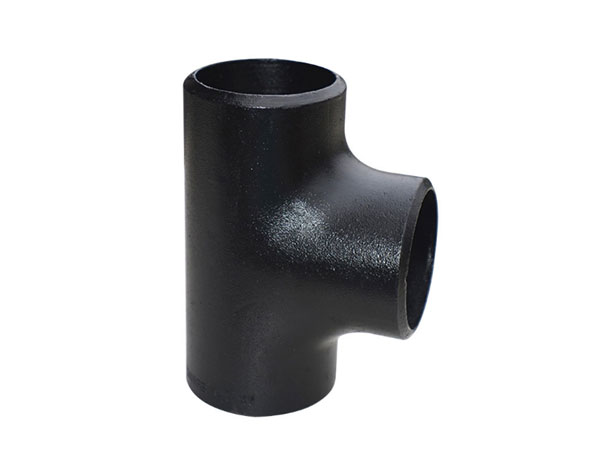
Zhantong produces equal and reducing tees and crosses to major standards. This article covers the decisions behind a correct branch connection.
Equal vs Reducing Tee
An equal tee has three same-diameter outlets for balanced branching. A reducing tee has a smaller branch (or run) to step down flow, avoiding a separate reducer and saving a weld.
Choosing the right type keeps velocity and pressure in the design envelope.
Tee and Cross Geometry
A tee joins a run and one branch at 90°; a cross adds a second perpendicular branch, used where four-way distribution is needed. Both are hot-formed or fabricated from pipe with reinforced walls at the junctions.
Reinforcement matters because branch intersections concentrate stress.
Standards and Schedules
Butt-weld tees follow ASME B16.9, with DIN 2615, JIS B2311 and GB/T 12459 common. Wall schedule must match the pipe; Zhantong supplies SCH 10–160 and STD/XS/XXS in carbon, stainless and alloy.
Olet-type branch connections are an alternative for high-pressure laterals.
Stress and Reinforcement
Branch openings weaken the run, so tee walls are thickened near the junction or area-replacement rules (ASME B31.3) are applied. For high-pressure laterals, reinforced branch fittings (weldolet) may be specified instead.
Proper design prevents leakage or fatigue at the crotch.
Applications
Tees serve distribution headers, fire-water networks, process skids and cooling systems. Crosses appear in manifolded utility and instrumentation lines where space allows.
In pipelines, tees also anchor pig traps and instrument taps.
Selection and Welding
Specify run/branch diameters, type (equal/reducing), schedule, material and standard. Align bores during fit-up and use qualified procedures; for reducing tees confirm flow direction if asymmetry matters.
Inspect the crotch area by RT/UT when the code requires it for pressure integrity.
Frequently Asked Questions
Equal or reducing tee?
Equal for same-size branching; reducing to step down flow without a separate reducer.
Which standard applies?
ASME B16.9, with DIN 2615 and GB/T 12459 common for butt-weld tees.
When use a weldolet instead?
For high-pressure laterals where area replacement and stress control demand reinforced branch fittings.
Must schedule match the pipe?
Yes, matching schedule keeps the bore continuous and pressure rating consistent.
Conclusion
Pipe tees and crosses are the junctions that make pipeline networks possible. Matching type, schedule and reinforcement to the service keeps every branch safe and balanced.
To discuss specifications, request a quote, or download full datasheets, visit www.zhantongpipe.com or contact our engineering team directly. Hebei Zhantong Pipeline Equipment Manufacturing Co., Ltd supports OEM drawings, third-party inspection, and worldwide shipping for every order.
 Recommended Products
 Contact us
—— Contact:Manager
—— Tel:+86 15231788966
—— Email:info@zhantongpipe.com
—— Url:https://www.zhantongpipe.com
—— Address:Mengcun Hui Autonomous County, Cangzhou City, Hebei Province