
NewsDetails
TPEP Anti-Corrosion Steel Pipe: Benefits and Applications
author:David Miller time:2026-11-09 14:02:51 Click:0
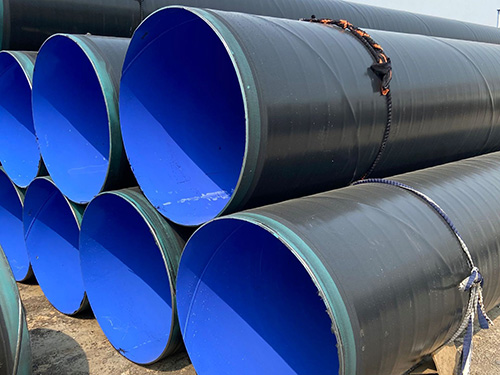
TPEP (Three-layer Polyethylene/Epoxy) anti-corrosion steel pipe is widely used in buried water, oil and gas pipelines. It combines the strength of steel with excellent corrosion protection, extending pipeline life to 30–50 years.
1. What Is TPEP Coating?
TPEP is a three-layer external coating system: a fusion bonded epoxy (FBE) primer, an adhesive copolymer interlayer, and a high-density polyethylene (HDPE) outer layer. The three layers are fused together during the extrusion process.
2. Key Benefits
- Excellent corrosion resistance — protects against soil corrosion, moisture and chemical attack.
- Mechanical protection — the tough outer layer resists impact and abrasion during handling and installation.
- Low friction coefficient — reduces pumping energy and improves flow efficiency.
- Long service life — designed for 30–50 years in buried applications.
3. Typical Applications
- Municipal water supply and drainage pipelines.
- Natural gas and crude oil transmission pipelines.
- Sewage treatment and reclaimed water systems.
- Piling and structural buried pipe applications.
4. Installation Tips
Handle TPEP pipes with non-metallic slings, avoid dragging on rough surfaces, and repair any coating damage with a polyethylene repair tape before backfilling.
Installation Tips for TPEP Coated Pipe
Proper installation ensures the coating performs as designed. Handle TPEP pipes with non-metallic slings, avoid dragging on rough surfaces, and repair any coating damage with polyethylene repair tape before backfilling. When welding, protect the coating from spatter with heat-resistant tape. Following these steps extends pipeline life.
Installation Tips for TPEP Coated Pipe
Proper installation ensures the coating performs as designed. Handle TPEP pipes with non-metallic slings, avoid dragging on rough surfaces, and repair any coating damage with polyethylene repair tape before backfilling. When welding, protect the coating from spatter with heat-resistant tape. Following these steps extends pipeline life and prevents early corrosion. Always follow the manufacturer's installation guidelines for jointing and backfilling procedures.
TPEP vs 3PE: What's the Difference?
TPEP and 3PE are both three-layer polyethylene coating systems, but they differ in the primer layer. TPEP uses fusion bonded epoxy (FBE) as the primer, while 3PE uses a modified epoxy powder. Both provide excellent corrosion protection, but TPEP generally offers better adhesion and cathodic disbondment resistance. The choice depends on the specific application, soil conditions and local standards. Consult with the coating manufacturer for the best recommendation.
| Feature | TPEP | 3PE |
|---|---|---|
| Primer | Fusion Bonded Epoxy | Modified Epoxy Powder |
| Adhesion | Excellent | Good |
| Cathodic Disbondment | Very good | Good |
| Typical Use | Water, gas, oil pipelines | Gas, oil pipelines |
TPEP Coated Pipe FAQ
Answers to the most common questions about TPEP anti-corrosion steel pipe.
- What does TPEP stand for? — TPEP stands for Three-layer Polyethylene with Epoxy Powder. It is a three-layer coating system: fusion bonded epoxy primer, adhesive middle layer, and polyethylene outer layer.
- How long does TPEP coating last? — With proper installation and maintenance, TPEP coating can last 30–50 years underground. The exact lifespan depends on soil conditions, burial depth and cathodic protection.
- Can TPEP pipe be welded? — Yes, but the coating must be protected during welding. Use heat-resistant tape to shield the coating from spatter, and repair the coating at the joint after welding with polyethylene repair tape.
- What is the typical coating thickness? — Total TPEP coating thickness is typically 1.5–3.0 mm, depending on the application. Thicker coatings are used for more aggressive soil conditions.
- Is TPEP better than 3PE? — Both are excellent, but TPEP uses FBE (fusion bonded epoxy) as the primer, which provides better adhesion and cathodic disbondment resistance. 3PE uses a modified epoxy powder. For most buried pipelines, both systems perform well.
TPEP Coating Inspection Methods
Quality control of TPEP coating includes several tests: visual inspection for holidays and defects, holiday spark testing to detect pinholes, thickness measurement with a magnetic gauge, and adhesion testing. Reputable manufacturers provide coating test reports with every batch.
Writer David Miller
David Miller is a technical writer and engineer with over 12 years of experience in the industry. He specializes in technical documentation, product specification and application engineering. David Miller holds a Bachelor's degree in Mechanical Engineering and has contributed to numerous technical publications on pipeline design, corrosion protection and industrial solutions.
 Recommended Products
 Contact us
—— Contact:Manager
—— Tel:+86 15231788966
—— Email:info@zhantongpipe.com
—— Url:https://www.zhantongpipe.com
—— Address:Mengcun Hui Autonomous County, Cangzhou City, Hebei Province