
NewsDetails
Insulated Steel Pipe for District Heating Systems
author:David Miller time:2026-11-11 14:55:43 Click:0
District heating networks rely on insulated steel pipes to transport hot water or steam from the source to end users. Proper insulation minimizes heat loss and ensures efficient energy distribution.
1. What Is Pre-Insulated Pipe?
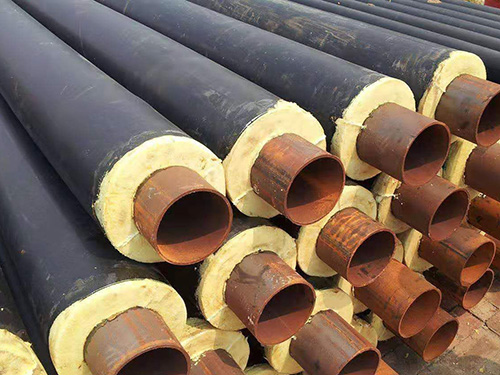
Pre-insulated pipe consists of a steel service pipe, a layer of polyurethane foam insulation, and a protective outer casing (usually HDPE). The three components are bonded together at the factory, ready for direct burial.
2. Key Benefits
- Low heat loss — polyurethane foam has excellent thermal conductivity, typically 0.024 W/(m·K).
- Factory quality — consistent insulation thickness and casing integrity.
- Fast installation — direct burial without additional insulation on site.
- Long service life — 30+ years with proper joints and corrosion protection.
3. Applications
- District heating and cooling networks.
- Industrial steam and condensate lines.
- Cold storage and cryogenic transfer lines.
- Underground hot water circulation systems.
Installation of Pre-Insulated Pipe
Pre-insulated pipe must be installed carefully to avoid damaging the casing and insulation. Use special welding fixtures for the steel service pipe, then weld the casing sleeves and apply heat-shrink joints. The joint area is the most vulnerable point — always follow the manufacturer's jointing procedure.
Installation of Pre-Insulated Pipe
Pre-insulated pipe must be installed carefully to avoid damaging the casing and insulation. Use special welding fixtures for the steel service pipe, then weld the casing sleeves and apply heat-shrink joints. The joint area is the most vulnerable point — always follow the manufacturer's jointing procedure. After installation, pressure test and leak check before backfilling. Proper installation ensures the insulation system performs as designed for decades.
District Heating System Design Considerations
Designing a district heating network requires careful hydraulic calculation, pipe sizing and insulation selection. The supply temperature typically ranges from 80°C to 120°C, with return temperature around 50–60°C. Pipe sizing must account for pressure drop, flow velocity and heat loss. Insulation thickness is selected based on the supply temperature and burial depth. Properly designed systems achieve heat losses below 10% of the generated heat.
| Parameter | Typical Range | Notes |
|---|---|---|
| Supply temp | 80–120°C | Depends on heat source |
| Return temp | 50–60°C | Delta T = 30–60°C |
| Insulation thickness | 30–80 mm | Polyurethane foam |
| Heat loss | <10% | Well-designed system |
District Heating Pipe FAQ
Answers to the most common questions about pre-insulated steel pipe for district heating.
- What temperature can pre-insulated pipe handle? — Standard pre-insulated pipe is rated for continuous operation up to 120°C, with peak temperatures up to 140°C. The polyurethane foam insulation maintains its properties within this range.
- What is the typical heat loss? — A well-designed district heating system has heat losses below 10% of the generated heat. The exact loss depends on insulation thickness, burial depth, soil temperature and pipe size.
- How long does pre-insulated pipe last? — With proper installation and maintenance, the service life is 30–50 years. The steel service pipe itself can last even longer — the insulation and casing are the limiting factors.
- How are joints insulated? — Field joints are insulated with polyurethane foam poured into a joint sleeve, then sealed with a heat-shrink sleeve. The joint is the most vulnerable point — always follow the manufacturer's jointing procedure.
- Can I use pre-insulated pipe above ground? — Yes, but above-ground piping requires additional protection against UV radiation and mechanical damage. Use metal cladding or paint the casing with UV-stabilized coating.
District Heating System Design Tips
Designing an efficient district heating network requires careful hydraulic calculation, pipe sizing and insulation selection. The supply temperature typically ranges from 80°C to 120°C, with return temperature around 50–60°C. Properly designed systems minimize heat loss and pumping energy.
Writer John Anderson
John Anderson is a technical writer and engineer with over 12 years of experience in the industry. He specializes in technical documentation, product specification and application engineering. John Anderson holds a Bachelor's degree in Mechanical Engineering and has contributed to numerous technical publications on pipeline design, corrosion protection and industrial solutions.
 Recommended Products
 Contact us
—— Contact:Manager
—— Tel:+86 15231788966
—— Email:info@zhantongpipe.com
—— Url:https://www.zhantongpipe.com
—— Address:Mengcun Hui Autonomous County, Cangzhou City, Hebei Province