
NewsDetails
TPEP Pipes vs Traditional Welded Pipes: Which Performs Better in 2025?
author:Zhantong time:2026-02-14 22:00:50 Click:114
As pipeline systems evolve, TPEP Pipes are becoming an important alternative to traditional welded pipes for water, gas, and industrial transportation. In 2025, engineers and project managers are paying closer attention to durability, corrosion resistance, and long-term operating cost when choosing pipe materials.
From a professional TPEP Pipes manufacturer perspective, advanced factory production and controlled processes play a major role in improving pipeline performance and supporting bulk supply for infrastructure projects. This article compares TPEP pipes with traditional welded pipes in terms of structure, performance, service life, and application value to help buyers make informed decisions.
What Are TPEP Pipes?
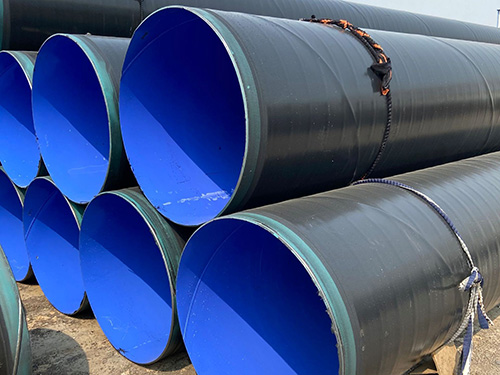
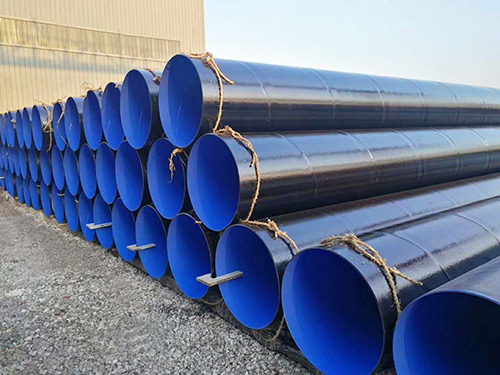
TPEP Pipes are steel pipes with a three-layer polyethylene anti-corrosion structure applied both internally and externally. The system typically includes:
·Epoxy powder coating layer
·Adhesive bonding layer
·Polyethylene protective layer
This composite structure provides strong mechanical strength from the steel core and excellent corrosion protection from the polymer layers. In modern TPEP pipes production, manufacturers integrate coating, curing, and inspection into a continuous factory manufacturing line to ensure uniform thickness and adhesion.
TPEP Pipes are commonly used for:
·Water supply networks
·Municipal engineering
·Industrial pipelines
·Underground transmission systems
What Are Traditional Welded Pipes?
Traditional welded pipes are formed by rolling steel plates or strips and joining them with longitudinal or spiral weld seams. These pipes rely mainly on steel properties for strength and basic surface treatments for corrosion protection.
Common types include:
·ERW pipes
·Spiral welded pipes
·Longitudinal welded pipes
In factory production, welded pipes focus on structural formation first, followed by optional coating or painting. While they provide good mechanical strength, corrosion protection often depends on additional processes added later.
Structural Differences Between TPEP Pipes and Welded Pipes
The core difference lies in construction.
TPEP Pipes combine:
·Steel pipe substrate
·Inner epoxy coating
·Adhesive interlayer
·Outer polyethylene jacket
This creates a sealed barrier against moisture, chemicals, and oxygen.
Traditional welded pipes mainly consist of:
·Steel body
·Weld seam
·External paint or simple coating
Without a fully integrated corrosion system, welded pipes are more exposed to environmental damage over time. Professional TPEP Pipes manufacturers design production lines to ensure tight bonding between layers, improving long-term stability.
Corrosion Resistance Performance in 2025
Corrosion remains one of the biggest challenges for pipelines.
TPEP Pipes
The internal and external anti-corrosion structure of TPEP Pipes provides:
·High resistance to soil moisture
·Protection from chemical attack
·Reduced scaling inside the pipe
·Lower friction loss
Factory production ensures uniform coating thickness, minimizing weak points that could lead to corrosion failure.
Traditional Welded Pipes
Welded pipes depend on external coatings and internal treatments added after fabrication. Weld seams are particularly vulnerable to corrosion if not perfectly protected.
In long-term service, traditional welded pipes may require more frequent maintenance, repairs, or replacement, increasing operating costs.
In 2025 infrastructure projects, TPEP Pipes generally outperform welded pipes in corrosion control.
Service Life and Maintenance Comparison
TPEP Pipes Service Life
Thanks to multi-layer protection, TPEP Pipes offer:
·Extended operational lifespan
·Lower leakage risk
·Minimal internal scaling
·Reduced maintenance cycles
Professional factory production controls bonding strength and curing temperature to ensure stable performance across large batch manufacturing.
Traditional Welded Pipes Service Life
Welded pipes provide reliable short- to medium-term performance but are more sensitive to:
·Soil corrosion
·Water chemistry
·Temperature fluctuation
·Weld seam degradation
This leads to higher inspection and maintenance frequency over time.
From a life-cycle cost perspective, TPEP Pipes often deliver better long-term value.
Installation and Construction Efficiency
Installation affects overall project efficiency.
TPEP Pipes feature:
·Smooth internal surfaces
·Stable dimensional accuracy
·Factory-integrated coating
·Reduced on-site anti-corrosion work
This saves installation time and minimizes post-welding treatment.
Traditional welded pipes often require additional field coating and seam protection after installation, increasing labor and time requirements.
For large-scale projects, bulk supply from a TPEP Pipes manufacturer with strong production capacity improves construction scheduling and consistency.
Cost Performance in 2025
Initial purchase cost for TPEP Pipes can be slightly higher than bare welded pipes. However, when considering:
·Reduced maintenance
·Longer service life
·Lower leakage risk
·Energy savings from smoother flow
TPEP Pipes show better total cost performance across the full operating cycle.
Factory production and batch manufacturing also help control unit cost for large infrastructure orders.
Environmental and Safety Advantages
In 2025, environmental compliance matters more than ever.
TPEP Pipes contribute to:
·Reduced water contamination risk
·Lower material degradation
·Improved pipeline hygiene
·Stable pressure transmission
Their sealed structure minimizes interaction between the steel core and transported media, supporting safer operation in municipal and industrial systems.
Production Capability and Supply Stability
Choosing between TPEP Pipes and traditional welded pipes is also about supplier capability.
Professional TPEP Pipes manufacturers invest in:
·Automated coating lines
·Adhesion testing systems
·Thickness monitoring
·Batch traceability
Modern factory production supports bulk manufacturing, ensuring consistent quality and stable delivery for long pipeline networks.
Traditional welded pipes also benefit from automation, but without integrated coating systems, performance uniformity can vary between batches.
Application Scenarios in 2025
TPEP Pipes are widely applied in:
·Municipal water projects
·Industrial fluid transmission
·Underground pipelines
·Infrastructure renewal
Traditional welded pipes remain suitable for:
·Structural use
·Short-term pipelines
·Non-corrosive environments
In performance-critical environments, TPEP Pipes are increasingly preferred.
Conclusion: Why TPEP Pipes Lead Performance in 2025
In conclusion, comparing TPEP Pipes with traditional welded pipes in 2025 highlights clear advantages in corrosion resistance, service life, maintenance efficiency, and overall performance.
With integrated anti-corrosion structure, smooth flow characteristics, and stable factory manufacturing, TPEP Pipes outperform conventional welded pipes for long-term infrastructure projects.
By selecting a professional TPEP Pipes manufacturer with strong production and factory bulk supply capability, project owners gain reliable quality, predictable delivery, and long-lasting pipeline performance.
For modern water, industrial, and municipal systems, TPEP Pipes continue to set the benchmark for efficient and durable pipeline solutions in 2025 and beyond.
References
GB/T 7714:Silman H. Corrosion and Corrosion Control: An introduction to corrosion science and engineering[J]. 1972.
MLA:Silman, H. "Corrosion and Corrosion Control: An introduction to corrosion science and engineering." (1972): 98-98.
APA:Silman, H. (1972). Corrosion and Corrosion Control: An introduction to corrosion science and engineering.
 Recommended Products
 Contact us
—— Contact:Manager
—— Tel:+86 15231788966
—— Email:info@zhantongpipe.com
—— Url:https://www.zhantongpipe.com
—— Address:Mengcun Hui Autonomous County, Cangzhou City, Hebei Province